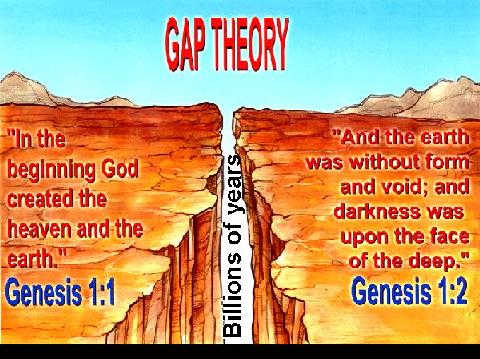
In Genesis 1:28 we read “…and God said unto them, Be fruitful, and multiply, and replenish the earth, and subdue it.” (KJV) The King James Version’s use of the word replenish has been seen by Gap Theorists as proof that the earth is old, since supposedly Adam and Eve are commanded to fill again. In fact, the idea that God commanded Adam and Eve not merely to fill the earth but to fill the earth again, stems from the Gap Theory.[i] The proponents of the Gap Theory believe that the billions of years of the age of the heavens and earth, as touted by evolutionistic thinking, is found between Genesis 1:1 and 1:2. Thus, did God command Adam and Eve to fill the earth for the very first time or to fill the earth again? Did they
Get all facts in the book.
actually understand that they were to fill the earth again because the world prior to their creation had been destroyed?
Replenish/Malu
It is true, that in today’s English, when we say replenish we mean filling up something that is depleted, something that was once full and is now empty. However, just less than 200 years ago, Webster’s Dictionary (1828) defines the word as, “To fill; to stock with numbers or abundance.” We can see that the word has changed from meaning fill to fill again today. Of course, the answer ultimately lies not in English but in Hebrew.
The Hebrew word מלאו (malu) does not mean to refill, but simply to fill. It in no way connotes or implies to fill again. It just means fill. God gave the same command to fill in Genesis 9:1 to Noah after the flood as He did to Adam and Eve. There is no question that Noah was to fill the earth again, but that is not intrinsically implied by the word; God simply said to fill the earth. Likewise, to suggest that God commanded Adam and Eve to repopulate a world that had been recreated is poor exegesis and is not even remotely supported from the text. We can, therefore, absolutely conclude that Adam and Eve simply understood God to be telling them to fill the earth for the first time and not to refill the world. They would absolutely not infer from God’s command that there had been a world gone bad prior to theirs. In fact, there are no words or verses that support such a claim.[ii]
[i] Weston W. Fields in his book Unformed and Unfilled (Presbyterian and Reformed Publishing Company, 1978) provides a thorough discussion of the Gap Theory and its fatal flaws. See also
For those acknowledging the reality that God was the agent of creation, there are four possible answers to the question of how He did it. The first view is that God took six, literal days as understood by the plain reading of the Genesis text, which is my thesis and is demonstrated in this teaching. (See The First Six Days) The other three views consider the evolutionary model to be an established fact and therefore seek to reconcile the revelation of Scripture regarding creation with evolution. The three views are Theistic Evolution, the Gap Theory, and Progressive Creationism.
Theistic Evolution
Theistic Evolution is the most liberal of the views that ascribes to God a role in creation as being the agent that jump-started the Big Bang. According to this theory, since then He has allowed evolution to take its course thereby having very little, if any, role in His creation and dealings with man.
The Gap Theory
Proponents of the Gap Theory see the days of Genesis 1 as being literal days but with a time gap between Genesis 1:1 and 1:2 (some also suggest a gap between 1:2 and 1:3). The rationale for seeking a gap, nevertheless, is due to the belief that (geological) evolution is an established fact and that the Bible must be reconciled to it. Hence, a time gap is envisioned between Genesis 1:1 and 1:2 (or 1:2-1:3), which allows for the billions of years supposedly necessary for geological evolution to take place. (I deal with this question in greater depth in my DVD teaching The Angelic Domain and the Fall of Satan and in article The Angelic Domain: Created Before Genesis 1:1 or After? and in my DVD The Language of Creation)
Progressive Creationism
Progressive Creationism seeks to reconcile the belief of evolution with the Bible, not by way of a gap between verses 1:1 and 1:2, but rather by redefining six days of Genesis 1 to mean indefinite periods of time in which millions and perhaps billions of years transpired each day. They see God as being involved in the entire process of creation wherein every day, God was creating via the evolutionary process.[2] Van Bebber and Taylor point out:
According to the Progressive Creationist timeline, Adam was, in effect, created on top of a graveyard of decaying or fossilized animals. Almost anywhere he walked, the remains of millions of dead animals were somewhere below his feet — evidence of death and frequent misery on a massive scale (2006).
Thus, for the Progressive Creationist, both the Bible and the evolutionary model complement one another because the biblical creation account is better understood through the lens of evolutionary thinking. Undoubtedly, most proponents of both the Gap Theory and Progressive Creationism believe in the authority of the Bible.
How Much Time Does God Need?
Rather than ask why couldn’t God have taken billions of years to accomplish His work of creation, the better question is why didn’t God speak once and everything merely come into existence as suggested by Augustine (see chapter 7)? God, the Supreme Being by which all things exist, could have snapped His divine fingers and everything would have come into being at once. Thus, even from a literal, six-day-creation standpoint, God took His time in a big way! Why did He take so long to create everything? God purposely slowed Himself down rather than just getting it over with. The reason, found in Exodus 20:11 (and 31:12-17), is that God wanted to establish a pattern which for mankind to follow; God worked for six days and then rested and so should man.
For in six days the LORD made the heavens and the earth, the sea, and all that is in them, and rested the seventh day. Therefore the LORD blessed the Sabbath day and hallowed it. (Exod 20:11)
[2] A more predominant Progressive Creationist view is that God created the animals as we see them today (i.e. fixity of species) and they lived and died out over millions or billions of years. However, proponents of this view, such as Hugh Ross, do not believe in molecules-to-man evolution, but they do accept the evolutionary timescale for the geologic and fossil records. (Dave Wright, Answers In Genesis staff, personal communication, June 9, 2007)
Many Christians have succumbed to the belief that God used the process of evolution within the creation framework. They would suggest that the six days of creation in Genesis were not absolute literal days of 24-hours but some how allowed for the slow process of billions of years of evolution. They accept the Bible as God’s divine book yet also accept the many facets of evolution as indisputable fact and are forced to squeeze the needed evolutionary time into the pages of the Bible. Before looking at the evolution plus God theories, however, let us first consider what exactly evolution is.
What is Evolution?
Evolution in its most basic sense is any process of formation or growth; development, derived from the Latin meaning unrolling, according to Random House Dictionary (2006). There are many things that evolve, so to speak, in our world. All that we mean, however, is that there is a slow, gradual change occurring in different facets of life. Let us consider a few examples.
The Changes in Language and Culture
We can speak of the slow progression of the English language as an example of evolution. The English of today is clearly not the same as that of Shakespeare’s day. They are both English, but many things have changed radically so that words and expressions of his day have a completely different meaning today. The change in language is something that happens slowly and in small increments, but we can all agree that it happens. Consider how it is that we use different expressions than our parents did and our kids use different words and expressions than we do.
Cultures are also going through a process of change or evolution as well. The culture of America is without doubt different today than it was 50 years ago. Things that were unacceptable back then are sometimes considered normal by today’s standards. In both of these examples, however, we are using the word evolution as a description of the slow change that is taking place and as such, the concept is completely acceptable. After all, these changes are observed linguistically and culturally by experts in the respective fields and simply by the general public. In other words, we can easily document and conclusively prove that those changes have actually occurred because the starting point is only 50 years ago and not 15 billion or even 6000 years ago.
From Micro to Macro to Abiogenesis
Douglas Futuyma, expert in biological evolution
Using the word evolution to describe the slow, steady changes that we undoubtedly witness in languages and cultures is indeed a correct use of the term. If that were the only way that it was used then there would be no problem whatsoever. However, the reality is that evolution has been given a new role and meaning; it is used to describe the entire progression of the universe starting with the Big Bang until the present day. The different phases of evolution include: particulate, galactic, stellar, planetary, chemical, biological and cultural.[1] Biological evolution purports to explain how life started from non-life (properly called abiogenesis) and then how those single-celled organisms eventually turned into you and me. Douglas Futuyma, a foremost expert in biological evolution notes,
In the broadest sense, evolution is merely change, and so is all-pervasive; galaxies, languages, and political systems all evolve. Biological evolution…is change in the properties of populations of organisms that transcend the lifetime of a single individual…Biological evolution may be slight or substantial; it embraces everything from slight changes in the proportion of different alleles within a population (such as those determining blood types) to the successive alterations that led from the earliest protoorganism to snails, bees, giraffes, and dandelions. (Futuyma 1986)
The above definition is rather misleading, however. Dr. Futuyma should define for us the three different concepts that he is dealing with under the broad category of biological evolution, which are: Natural Selection (adaptation to an environment, which is sometimes called microevolution), molecules-to-man evolution (change in kind, e.g. reptile to bird, which is sometimes called macroevolution) and abiogenesis (a nonliving piece of rock to a living single-celled organism). Neither the Bible nor literal six-day creationists are in any way against the concept of Natural Selection, which was actually first introduced by a creationist Edward Blythe. Changes in species populations, by adapting to their environment, have in fact been witnessed to occur.
Charles Darwin correctly noted that the beaks of the finches on theGalapagos Islandschanged according to the climatic conditions. He called this evolution. From there he postulated his theory that these small changes, given enough time, could account for all of the living creatures on earth. Darwinfailed to note, however, that the finches were still finches. They never turned into something else other than finches. Darwinobserved the species’ ability to adapt to its surrounding (which is easily ascribed to an amazing Creator) and from there made the leap of faith that with the magical element of time, one creature will turn into another.
According to Its Kind
The belief in molecules-to-man evolution – that single-celled organisms turned into more complex creatures, which turned into something else, all the way to you and me – is what stands in direct conflict with the Bible and specifically the six days of creation. Genesis 1:24 specifically states that on the fifth day, “Then God said, ‘Let the earth bring forth the living creature according to its kind [מין min]: cattle and creeping thing and beast of the earth, each according to its kind’; and it was so.” This verse acts as an insurmountable obstacle to those who would try to bridge (macro)evolution and the Bible. God’s words cannot be misconstrued here. He plainly says that different living creatures will come forth according to their own kind and not from one common ancestor of all. He then defines what He means by enumerating the creatures: “cattle and creeping thing and beast of the earth”, rendering impossible the paradigm that everything came from a different creature smaller and simpler than itself. The Theological Wordbook of the Old Testament explains:
Some have argued that when God created “min” [class, kind, species], he thereby fixed the “species.” This is a gratuitous assumption because a link between the word “min” with the biologist’s descriptive term “species” cannot be substantiated, and because there are as many definitions of species as there are biologists…God created the basic forms of life called “min” which can be classified according to modern biologists and zoologists as sometimes species, sometimes genus, sometimes family or sometimes order. This gives no support to the classical evolutionist’s view which requires developments across kingdom, phyla, and classes.
Dogs Are Still Dogs
Animals reproducing fertile offspring according to their own kind, is what we see in nature. We see hundreds of varieties of dogs, but dogs are still dogs. This (largely human-caused) variation in dogs is often called evolution. This is reflected in the Seed Magazine article “The Human-Influenced Evolution of Dogs” (Anthes 2006), which discusses not the macroevolution of how a non-dog turned into a dog, but how through human intervention “the domestication of dogs by humans has given rise to the immense diversity of the canine species by allowing otherwise harmful genetic mutations to survive.” (Anthes 2006) This “evolution” that Anthes refers to is nothing more than variation within a kind. Nevertheless, she is echoed by theNaturalHistoryMuseum inLondon which says that the breeding of dogs shows evolution as well. (Batten 1996) Here again, we are given an example of Natural Selection (adaptation and variation, which are factual and observed) and are led to believe that it is equivalent to molecules-to-man evolution.
However, there is no “evolution” of the dog at all, other than variation due greatly to humans. Interestingly, the study of genetics confirms that all dogs have come from a common ancestry. “Most breeds have developed during the past 500 years, […] Before humans began breeding dogs for certain traits or behaviors, dogs were more general in their appearance or morphology […]” (Dalke 2002). The multiplicity of dogs is not a proof of evolution but of dog’s best friend manipulating him to better suit man. “Breeds tell us more about human preferences than about dogs […] Dog breeds are the result of human preferences—selected traits taken from generation to generation.” (Dalke 2002). “The Human-Influenced Evolution of Dogs” would be better titled “Man’s Breeding of Dogs”.
When God says in the beginning He created the Heavens and the Earth, could He have just been talking about our heavens that include the stars and sky and the beginning of our dimension? He never addresses anything about angels or sons of God or His throne or His heaven or anything in His realm when talking about the creation in Genesis that I remember, so could He have already created His Heaven and the angels etc before that and just chose to tell us the story about the creation and beginning of our world and dimension since He left all of that out. It does say the morning stars sang together and the sons of God shouted for joy when the foundations of the earth were laid in Job . I’m just wondering why we have to believe that the creation of the realm where God dwells and it’s inhabitants have to be included at the same time as the creation in Genesis when none of it is mentioned as the story is told. I have been a christian my whole life and just never thought that God’s realm was created at the same time as our realm because I don’t remember it being talked about in the bible. Maybe I’m missing verses that would dispute this. I look forward to your reply when you can get to it. Thanks again!
– Jon
The Bible does not articulate when God created the angels like it does with man. However, we can piece together some clues from the book of Job 38 where we read:
“Where were you when I laid the foundations of the earth? Tell [Me,] if you have understanding. (Job 38:4) Who determined its measurements? Surely you know! Or who stretched the line upon it? (Job 38:5) To what were its foundations fastened? Or who laid its cornerstone, (Job 38:6) When the morning stars sang together, And all the sons of God shouted for joy? (Job 38:7) “Or [who] shut in the sea with doors, When it burst forth [and] issued from the womb; (Job 38:8) When I made the clouds its garment, And thick darkness its swaddling band; (Job 38:9) When I fixed My limit for it, And set bars and doors; (Job 38:10)
He stretched a line upon it
Notice that the earth is already up to day day two – we know this because the line has been stretched out upon it. The line was pointed out to me, by a brother (whose name I forget), to be the place where day and night meet on the earth as seen from space – it literally is a line passing over it.
Therefore, the angels appear to have been there at least on day two. But were they there before that? This next part requires several verses to come to an understanding – I will give an abbreviated answer here but many of the proofs are discussed in my course on the Messianic Age which you can listen to here.
There is a currently a veil between the heavenly domain/realm and the earthly. We learn this from Isaiah 25:7 which states that the veil, which covers all nations, is going to be removed
And He will destroy on this mountain The surface of the covering cast over all people, And the veil that is spread over all nations. (Isa 25:7) He will swallow up death forever, And the Lord GOD will wipe away tears from all faces; The rebuke of His people He will take away from all the earth; For the LORD has spoken. (Isa 25:8)
Isaiah also says in chapter 64:1 oh that you would rend the heavens and come down. We hear of the sky receding like a scroll in Isaia 34 and Revelation 6. The prophets also saw the heavens open on occasion (Ezekiel 1, Revelation 4, 19). Stephen also saw the heavens open when he was being stoned (Acts 7).
We also know that Satan was in Eden, the garden of God, which was associated with the mountain of God (Ezekiel 28:12-18). That mountain is the same mountain that we read about in Isaiah 14 (which Satan attempted to climb and sit upon) and it is also the same that is spoken of in Hebrews 12:22
But you have come to Mount Zion and to the city of the living God, the heavenly Jerusalem, to an innumerable company of angels, (Heb 12:22)
The mountain of God is in fact the heavenly Jerusalem according to this verse.
Therefore, the abode of God was created when He created everything else and also that abode was in this domain/dimension before the fall. God walked in the cool of the evening in the Garden of Eden which is the same place that Satan was – and again, the mountain of God was located at the same place. This means that God’s abode and man’s were in the same dimension and only split after the sentencing and casting out from the Garden with the way blocked to the tree of life. In other words, the casting out was not simply a spacial removal but a dimensional removal. The spiritual dimension was divorced from the natural/physical at that point and those two will be recombined when the New Jerusalem comes down out of heaven and remains on the earth forever.
With all that in view we see that before the creation of the heavens and earth there was only God who existed in and of His own dimension. There was no other space out there, no black emptiness, no void – it was just God. There was only light for even darkness is something that He created (Isaiah 45:7). We also conclude that the traditional view that we have in which God’s abode in “heaven” has always been the original intent is wrong. God’s original intent was to dwell with His creatures on the earth! What we understand to be “heaven” in the Scriptures is in fact the Holy Mountain/Heavenly Jerusalem – which comes down to the earth in the age to come. So we conclude that only God existed before Genesis 1:1. The current separation of God’s domain from man’s is only a temporary condition which was not in place when God declared everything to be very good. As for the angels, they were therefore created after the heavens and earth of Genesis 1:1 and were dwelling in the same domain as man until the separation of the two.
One of the tasks Adam was given on the first day of his creation was to name the animals, an act that demonstrated his
Adam names animals
dominion over them as God had prescribed (Genesis 1:26, 28). Yet, therein lies a supposed problem that the day-age theory would presumably solve: if those days were not day-ages and death had not entered until Adam sinned, then why would Adam give names to animals that denote their carnivorous nature (such as bird of prey)? The proponents of Progressive Creationism have suggested that Adam was familiar with death, even before the creation of Eve, which would explain why he would give the animals names that fit their ferocious nature. Progressive Creationist Richard Deem explains:
When Adam was first put into the garden, God said that he could eat from any tree except the tree of the knowledge of good and evil (Genesis 2:15-17). God threatened that Adam would “surely die” if he broke this command. This threat makes no sense unless Adam had already seen the death of animals. There is no recorded reply of Adam asking what death was. If he had never seen death this would have been an obvious question. This is strong biblical evidence that Adam had already seen the death of animals even before Eve was created. In addition, Adam’s choice of names for the animals indicated that he had seen them kill other animals. For example, the Hebrew name for lion is derived from the Hebrew root that means “in the sense of violence.” In addition, Adam named some of the predatory birds using a Hebrew word with the meaning “bird of prey.” In naming the eagle, Adam used the Hebrew word whose root means to lacerate. So, scripture suggests that there was animal death before the fall of Adam and Eve. (Deem 2006a)
Suggesting that Adam must have known what death was first hand in order to understand God’s directive is nothing more than speculation and not necessary since any child can understand the idea of death without having a family member die. To suggest that Adam knew what death was based on the names of the animals is not logical. Furthermore, Deem has assumed that Adam spoke Hebrew. While it is possible that Hebrew was the original language, there is no way to be sure that Adam and Eve didn’t speak a completely different language. The above author is putting words into Adam’s mouth that are not in the text. Because the Bible is God’s Word, we want to be careful not to add or subtract from it, but just understand what is given.
Did Adam really include in the name lion the meaning of “in a sense of violence”? We agree that when we look up the Hebrew word אריה aryeh in the popular Strong’s Dictionary, the definition does in fact say “in a sense of violence.” But this does not in any way imply that Adam while in the Garden of Eden was thinking to himself, “Gee, what should I call this animal? Hmm, well, it has big teeth and I have seen it kill and eat other animals! I need to call it something that is characteristic of its violent nature. I know! I will call it aryeh (or in English violence).”
The reality is that Strong’s Dictionary and other lexicons sometimes make an educated guess. When compiling a lexicon (dictionary) of ancient languages, the authors study the available writings and begin to formulate their ideas from there. There is no master copy of original meanings that they can consult. Some words are much easier than others due to their high frequency. The meaning of others, which are used only once in the entire Bible, known as hapax legomenon, and must be deduced from the surrounding vocabulary. An example of such an occurrence is found in Isaiah:
The wild beasts of the desert shall also meet with the jackals, and the wild goat shall bleat to its companion; also the night creature (ליליתlilit) shall rest there, and find for herself a place of rest. (Isaiah 34:14)
The term night creature is the Hebrew word lilit which occurs only here in the entire Bible. Even if it were to have been uttered by Adam, this would not tell us what it means. Thus, the translation night creature is only an educated guess on the part of the translator due to its similarity to the Hebrew word לילה layla meaning night.
Parallelisms
Another tool the translator can use to help clarify a text is parallelisms. Parallelisms are times when the biblical author followed the word in question with a synonym in close proximity. We see this style of parallelism often in the Proverbs where an idea is expressed two (or more) different words. Consider the following example from Proverbs 2:10-11:
When wisdom enters your heart,
And knowledge is pleasant to your soul,
Discretion will preserve you;
Understanding will keep you.
There are several clues that would help us understand if one or two of these words were difficult since each verse is a pair of words meaning approximately the same thing:
wisdom – knowledge
heart – soul
discretion – understanding
preserve – keep
The words in this passage are fairly easy, but we can see how if we didn’t know one, we could make an educated guess based on the context and meaning of the other. This is how many words are ascribed their meaning in the Bible – not from looking at a lexicon or dictionary, but from studying the context in which the word is used; so too with the word lion. The various authors of Hebrew lexicons such as Strong’s, Brown Driver Briggs (BDB), and others do not know the original meaning of the word. However, they have observed the animal lion and how it is generally portrayed in Scripture as “in a sense of violence.” But we must recognize that “in a sense of violence” is not the true meaning of the word lion, which is the translation of the Hebrew aryeh. The same is true of the birds of prey. Adam, didn’t look at them and say to himself, “Hmm… I think that I will name you ‘bird of prey’ (Hebrew ayit עיט).” Again, modern scholars don’t know what the etymology of עיט (ayit) is so they gave it a general term “bird of prey” for that is what it is. Let’s consider an example in English that is similar.
Etymologies
When we say God we are referring to the Supreme Being who is the Sovereign of the universe. Looking in Collins’ English Dictionary we see that the definition of God is “a supernatural being, who is worshipped as the controller of some part of the universe or some aspect of life in the world or is the personification of some force.” But what is the origin of the word? We have seen the definition of the word, but where did it come from? Does the origin stem from supreme being, or powerful one? Is it related to the word good?
To answer these questions we must consult an etymological dictionary which gives a history of origin of words. According to the Online Etymological Dictionary, god (or God)in old English did mean supreme being. That, however, is not the end of the story. In Proto-Indo-European, the predecessor to English, it was spelled ghut which meant that which is invoked. Although some trace it to an alternate Proto-Indo-European root ghu-to meaning poured, from the root *gheu meaning to pour, pour a libation. The etymological dictionary also notes that it is not related to the word good. So, we see in a word we use every day that it had an origin that probably none of us knew before. We might have thought that it was related to good since God is good and if not that, then at least it came from supreme being.
However, the original meaning is neither supreme being nor good but is rather that which is invoked or poured. This is informative since it demonstrates that a definition and origin (etymology) are not necessarily the same. Thus to suggest that Adam was familiar with death before the fall and therefore called the lion violent and eagles and vultures birds of prey is anachronistic. We simply don’t know what Adam meant by the names that he gave. All that we know is that in the Bible, the Hebrew words aryeh – lion and ayit – birds of prey are the meanings of those words as derived by scholars according to how the words are used, not according to their original meaning.
Replenish the Earth and the Gap Theory
In Genesis 1:28 we read “…and God said unto them, Be fruitful, and multiply, and replenish the earth, and subdue it.” (KJV) The King James Version’s use of the word replenish has been seen by Gap Theorists as proof that the earth is old, since supposedly Adam and Eve are commanded to fill again. In fact, the idea that God commanded Adam and Eve not merely to fill the earth but tofill the earth again, stems from the Gap Theory.[i] The proponents of the Gap Theory believe that the billions of years of the age of the heavens and earth, as touted by evolutionistic thinking, is found between Genesis 1:1 and 1:2. Thus, did God command Adam and Eve to fill the earth for the very first time or to fill the earth again? Did they actually understand that they were to fill the earth again because the world prior to their creation had been destroyed?
Replenish/Malu
It is true, that in today’s English, when we say replenish we mean filling up something that is depleted, something that was once full and is now empty. However, just less than 200 years ago, Webster’s Dictionary (1828) defines the word as, “To fill; to stock with numbers or abundance.” We can see that the word has changed from meaning fill to fill again today. Of course, the answer ultimately lies not in English but in Hebrew.
The Hebrew word מלאו (malu) does not mean to refill, but simply to fill. It in no way connotes or implies to fill again. It just means fill. God gave the same command to fill in Genesis 9:1 to Noah after the flood as He did to Adam and Eve. There is no question that Noah was to fill the earth again, but that is not intrinsically implied by the word; God simply said to fill the earth. Likewise, to suggest that God commanded Adam and Eve to repopulate a world that had been recreated is poor exegesis and is not even remotely supported from the text. We can, therefore, absolutely conclude that Adam and Eve simply understood God to be telling them to fill the earth for the first time and not to refill the world. They would absolutely not infer from God’s command that there had been a world gone bad prior to theirs. In fact, there are no words or verses that support such a claim.[ii]
[i] Weston W. Fields in his book Unformed and Unfilled (Presbyterian and Reformed Publishing Company, 1978) provides a thorough discussion of the Gap Theory and its fatal flaws. See also


 Bang. According to this theory, since then He has allowed evolution to take its course thereby having very little, if any, role in His creation and dealings with man.

 Many Christians have succumbed to the belief that God used the process of evolution within the creation framework. They would suggest that the six days of creation in Genesis were not absolute literal days of 24-hours but some how allowed for the slow process of billions of years of evolution. They accept the Bible as God’s divine book yet also accept the many facets of evolution as indisputable fact and are forced to squeeze the needed evolutionary time into the pages of the Bible. Before looking at the evolution plus God theories, however, let us first consider what exactly
 evolution is.


 Facebook
 Twitter
 GooglePlus
 RSS
 Youtube
 Newsletter
 Email Me New Posts!
