Hanukkah Is The Twenty-Fifth Of Kislev In The Winter Season
Hanukkah Is The Twenty-Fifth Of Kislev In The Winter Season
By Dr. Douglas Hamp
In this article, I intend to show that Hanukkah is indeed in the month of Kislev which occurs in the winter season. It is not a modern December-holiday created as an alternative to Christmas. Its origin is ancient and is absolutely based on ancient primary sources. We will see Hanukkah happened in winter based on John 10:22 and that winter was definitely in the ninth month based on the reading from Jeremiah 36:22. We will then see that both Maccabees and Josephus specifically state it was the 25h of Kislev.
If Hanukkah had been on the last day of the feast of Sukkot, then it is suspiciously absent from the records we have. There is no doubt in my mind that the 25th of Kislev is the correct date of Hanukkah and it falls in the general time of December.
Sukkot occurs in the seventh month which is around Sept or October on the Gregorian calendar.
‘The fifteenth day of this seventh month shall be the Feast of Tabernacles for seven days to the LORD. (Lev 23:34)
The text of John 10:22 seems clear: “it was winter” whereas khimon χειμων is the Greek equivalent of חורף – that is “winter.”
Now it was the Feast of Dedication in Jerusalem, and it was winter. (John 10:22)
εγενετο δε τα εγκαινια εν τοις ιεροσολυμοις και χειμων ην (John 10:22)
We also have strong biblical confirmation of this in Jeremiah in which winter happened in the ninth month. God told us the first month was Aviv which is essentially April – counting forward to the ninth month, we come to November/December:
Now the king was sitting in the winter house in the ninth month, with a fire burning on the hearth before him. (Jer 36:22)
I have not found any references to Hanukkah falling on the last day of Sukkot in any literature including primary sources. I have included the relevant primary resources below and highlighted the important parts demonstrating Hanukkah is in the month of Kislev, which happens in the winter and in the ninth month (Nov-Dec) according to Jeremiah.
1 Maccabees 1:54-60 clearly states the date as the 25th of Kislev:
54 Now on the fifteenth day of Chislev, in the one hundred forty-fifth year, they erected a desolating sacrilege on the altar of burnt offering. They also built altars in the surrounding towns of Judah, 55 and offered incense at the doors of the houses and in the streets. 56 The books of the law that they found they tore to pieces and burned with fire. 57 Anyone found possessing the book of the covenant, or anyone who adhered to the law, was condemned to death by decree of the king. 58 They kept using violence against Israel, against those who were found month after month in the towns. 59 On the twenty-fifth day of the month they offered sacrifice on the altar that was on top of the altar of burnt offering. 60 According to the decree, they put to death the women who had their children circumcised,
I Maccabees is the next to reveal that the dedication of the temple happened in the same month of Kislev, which we know to be Nov-Dec on the Gregorian calendar. I have included the Greek to be able to dig deeper. Also notice that they celebrated this feast for eight days.
1 Maccabees 4:56-61[1]
55 Thereupon all the people fell down face to earth, to adore and praise, high as heaven, the author of their felicity; 56 and for eight days together they celebrated the altar’s renewal [τὸν ἐγκαινισμὸν, [2] = feast of renovation or consecration] burned victim and brought welcome-offering with glad and grateful hearts. 57 They decked the front wall of the temple, at this time, with gold crowns and escutcheons, consecrated the gates and the priest’s lodging anew, and furnished it with doors; 58 and all the while there was great rejoicing among the people; as for the taunts of the heathen, they were heard no more. 59 No wonder if Judas and his brethren, with the whole assembly of Israel, made a decree that this feast should be kept year by year for eight days together, the feast-day of the altar’s dedication [τοῦ ἐγκαινισμοῦ, = feast of renovation or consecration]. [4] Came that season, from the twenty-fifth day of Casleu onwards, all was to be rejoicing and holiday. 60 At this time, too, they fortified the hill of Sion, with walls and strong towers all about; never more should Gentile feet profane it. 61 Judas put a garrison there, and would have it strong enough to command Bethsura; a bulwark Israel must have against attack from the frontiers of Edom.
56 καὶ ἐποίησαν τὸν ἐγκαινισμὸντοῦ θυσιαστηρίου ἡμέρας ὀκτὼ καὶ προσήνεγκαν ὁλοκαυτώματα με{T’} εὐφροσύνης καὶ ἔθυσαν θυσίαν σωτηρίου καὶ αἰνέσεως 57 καὶ κατεκόσμησαν τὸ κατὰ πρόσωπον τοῦ ναοῦ στεφάνοις χρυσοῖς καὶ ἀσπιδίσκαις καὶ ἐνεκαίνισαν τὰς πύλας καὶ τὰ παστοφόρια καὶ ἐθύρωσαν αὐτά 58 καὶ ἐγενήθη εὐφροσύνη μεγάλη ἐν τῷ λαῷ σφόδρα καὶ ἀπεστράφη ὀνειδισμὸς ἐθνῶν 59 καὶ ἔστησεν Ιουδας καὶ οἱ ἀδελφοὶ αὐτοῦ καὶ πᾶσα ἡ ἐκκλησία Ισραηλ ἵνα ἄγωνται αἱ ἡμέραι τοῦ ἐγκαινισμοῦ τοῦ θυσιαστηρίου ἐν τοῖς καιροῖς αὐτῶν ἐνιαυτὸν κα{T’} ἐνιαυτὸν ἡμέρας ὀκτὼ ἀπὸ τῆς πέμπτης καὶ εἰκάδος τοῦ μηνὸς Χασελευ με{T’} εὐφροσύνης καὶ χαρᾶς 60 καὶ ᾠκοδόμησαν ἐν τῷ καιρῷ ἐκείνῳ τὸ ὄρος Σιων κυκλόθεν τείχη ὑψηλὰ καὶ πύργους ὀχυρούς μήποτε παραγενηθέντα τὰ ἔθνη καταπατήσωσιν αὐτά ὡς ἐποίησαν τὸ πρότερον 61 καὶ ἀπέταξεν ἐκεῖ δύναμιν τηρεῖν αὐτὸ καὶ ὠχύρωσεν αὐτὸ τηρεῖν τὴν Βαιθσουραν τοῦ ἔχειν τὸν λαὸν ὀχύρωμα κατὰ πρόσωπον τῆς Ιδουμαίας
Josephus very clearly confirms the date of the 25th of Kislev, the celebration for eight days, and the name: the festival of lights.
Now it came to pass, after two years, in the hundred forty and fifth year, on the twenty-fifth day of that month which is by us called Chasleu, and by the Macedonians Apelleus, in the hundred and fifty-third olympiad, that the king came up to Jerusalem, and, pretending peace, he got possession of the city by treachery; at which time he spared not so much as those that admitted him into it, on account of the riches that lay in the temple; but, led by his covetous inclination, (for he saw there was in it a great deal of gold, and many ornaments that had been dedicated to it of very great value,) and in order to plunder its wealth, he ventured to break the league he had made. So he left the temple bare, and took away the golden candlesticks, and the golden altar [of incense], and table [of shew-bread], and the altar [of burnt-offering]; and did not abstain from even the veils, which were made of fine linen and scarlet. (Jos. Antiq. xii. 5, 4)
When therefore the generals of Antiochus’s armies had been beaten so often, Judas assembled the people together, and told them, that after these many victories which God had given them, they ought to go up to Jerusalem, and purify the temple, and offer the appointed sacrifices. But as soon as he, with the whole multitude, was come to Jerusalem, and found the temple deserted, and its gates burnt down, and plants growing in the temple of their own accord, on account of its desertion, he and those that were with him began to lament, and were quite confounded at the sight of the temple; so he chose out some of his soldiers, and gave them order to fight against those guards that were in the citadel, until he should have purified the temple. When therefore he had carefully purged it, and had brought in new vessels, the candlestick, the table [of shew-bread], and the altar [of incense], which were made of gold, he hung up the veils at the gates, and added doors to them. He also took down the altar [of burnt-offering], and built a new one of stones that he gathered together, and not of such as were hewn with iron tools. So on the five and twentieth day of the month Casleu, which the Macedonians call Apeliens, they lighted the lamps that were on the candlestick, and offered incense upon the altar [of incense], and laid the loaves upon the table [of shew-bread], and offered burnt-offerings upon the new altar [of burnt-offering]. Now it so fell out, that these things were done on the very same day on which their Divine worship had fallen off, and was reduced to a profane and common use, after three years’ time; for so it was, that the temple was made desolate by Antiochus, and so continued for three years. This desolation happened to the temple in the hundred forty and fifth year, on the twenty-fifth day of the month Apeliens, and on the hundred fifty and third olympiad: but it was dedicated anew, on the same day, the twenty-fifth of the month Apeliens, on the hundred and forty-eighth year, and on the hundred and fifty-fourth olympiad. And this desolation came to pass according to the prophecy of Daniel, which was given four hundred and eight years before; for he declared that the Macedonians would dissolve that worship [for some time].[3]
- Now Judas celebrated the festival of the restoration of the sacrifices of the temple for eight days [ἐφ᾽ἡμέραςὀκτὼ], and omitted no sort of pleasures thereon; but he feasted them upon very rich and splendid sacrifices; and he honored God, and delighted them by hymns and psalms. Nay, they were so very glad at the revival of their customs, when, after a long time of intermission, they unexpectedly had regained the freedom of their worship, that they made it a law for their posterity, that they should keep a festival, on account of the restoration of their temple worship, for eight days [ἡμέρας ὀκτώ]. And from that time to this we celebrate this festival, and call it Lights [φῶτα]. I suppose the reason was, because this liberty beyond our hopes appeared to us; and that thence was the name given to that festival. Judas also rebuilt the walls round about the city, and reared towers of great height against the incursions of enemies, and set guards therein. He also fortified the city Bethsura, that it might serve as a citadel against any distresses that might come from our enemies. (Jos. Antiq. xii. 7, 6-7)[4]
In conclusion:
We learned that Hanukkah happened in winter based on our reading of John 10:22 Jeremiah 36:22 recorded that the ninth month (Nov-Dec) was considered winter. Both Maccabees and Josephus specifically stated Hanukkah, the dedication of the temple, was the 25th of Kislev, it lasted eight days, and was called the feast of lights. There is no mention whatsoever in the source literature that Hanukkah fell on the last day of the feast of Sukkot, which would have been a significant detail to include in the record. I believe we can confidently trust that the timing of Hanukkah is completely independent of Sukkot and, as people have celebrated for generations, it falls in the general time of December.
[1] https://www.biblestudytools.com/rsva/1-maccabees/passage/?q=1-maccabees+4:56-61
[2] ἐγκαίν-ια , τά , ( καινός ) feast of renovation or consecration , Thd. Da. 3.2, LXX 2 Es. 6.16 ; esp. that established by Judas Maccabaeus at the reconsecration of the Temple, Ev.Jo. 10.22
[3] ἔτει γὰρ πέμπτῳ καὶ τεσσαρακοστῷ καὶ ἑκατοστῷ ταῦτα περὶ τὸν ναὸν ἐγένετο, πέμπτῃ δὲ καὶ εἰκάδι τοῦ Ἀπελλαίου μηνὸς ὀλυμπιάδι ἑκατοστῇ καὶ πεντηκοστῇ καὶ τρίτῃ, ἀνενεώθη [renewed] δὲ κατὰ τὴν αὐτὴν ἡμέραν πέμπτῃ καὶ εἰκοστῇ τοῦ Ἀπελλαίου μηνὸς ὀγδόῳ καὶ τεσσαρακοστῷ καὶ ἑκατοστῷ ἔτει ὀλυμπιάδι ἑκατοστῇ καὶ πεντηκοστῇ καὶ τετάρτῃ. [322] τὴν δ᾽ ἐρήμωσιν τοῦ ναοῦ συνέβη γενέσθαι κατὰ τὴν Δανιήλου προφητείαν πρὸ τετρακοσίων καὶ ὀκτὼ γενομένην ἐτῶν: ἐδήλωσεν γάρ, ὅτι Μακεδόνες καταλύσουσιν αὐτόν.
[4] Ἑώρταζε δὲ ὁ Ἰούδας μετὰ τῶν πολιτῶν τὴν ἀνάκτησιν τῆς περὶ τὸν ναὸν θυσίας ἐφ᾽ ἡμέρας ὀκτὼ μηδὲν ἀπολιπὼν ἡδονῆς εἶδος, ἀλλὰ πολυτελέσι μὲν καὶ λαμπραῖς ταῖς θυσίαις κατευωχῶν αὐτούς, ὕμνοις δὲ καὶ ψαλμοῖς τὸν μὲν θεὸν τιμῶν αὐτοὺς δὲ τέρπων. [324] τοσαύτῃ δ᾽ ἐχρήσαντο τῇ περὶ τὴν ἀνανέωσιν τῶν ἐθῶν ἡδονῇ μετὰ χρόνον πολὺν ἀπροσδοκήτως ἐν ἐξουσίᾳ γενόμενοι τῆς θρησκείας, ὡς νόμον θεῖναι τοῖς μετ᾽ αὐτοὺς ἑορτάζειν τὴν ἀνάκτησιν τῶν περὶ τὸν ναὸν ἐφ᾽ ἡμέρας ὀκτώ. [325] καὶ ἐξ ἐκείνου μέχρι τοῦ δεῦρο τὴν ἑορτὴν ἄγομεν καλοῦντες αὐτὴν φῶτα ἐκ τοῦ παρ᾽ ἐλπίδας οἶμαι ταύτην ἡμῖν φανῆναι τὴν ἐξουσίαν τὴν προσηγορίαν θέμενοι τῇ ἑορτῇ. [326] τειχίσας δ᾽ ἐν κύκλῳ τὴν πόλιν καὶ πρὸς τὰς ἐπιδρομὰς τῶν πολεμίων πύργους οἰκοδομησάμενος ὑψηλοὺς φύλακας ἐν αὐτοῖς ἐγκατέστησεν, καὶ τὴν Βεθσούραν δὲ πόλιν ὠχύρωσεν, ὅπως ἀντὶ φρουρίου αὐτῇ πρὸς τὰς ἀπὸ τῶν πολεμίων ἀνάγκας ἔχῃ χρῆσθαι.
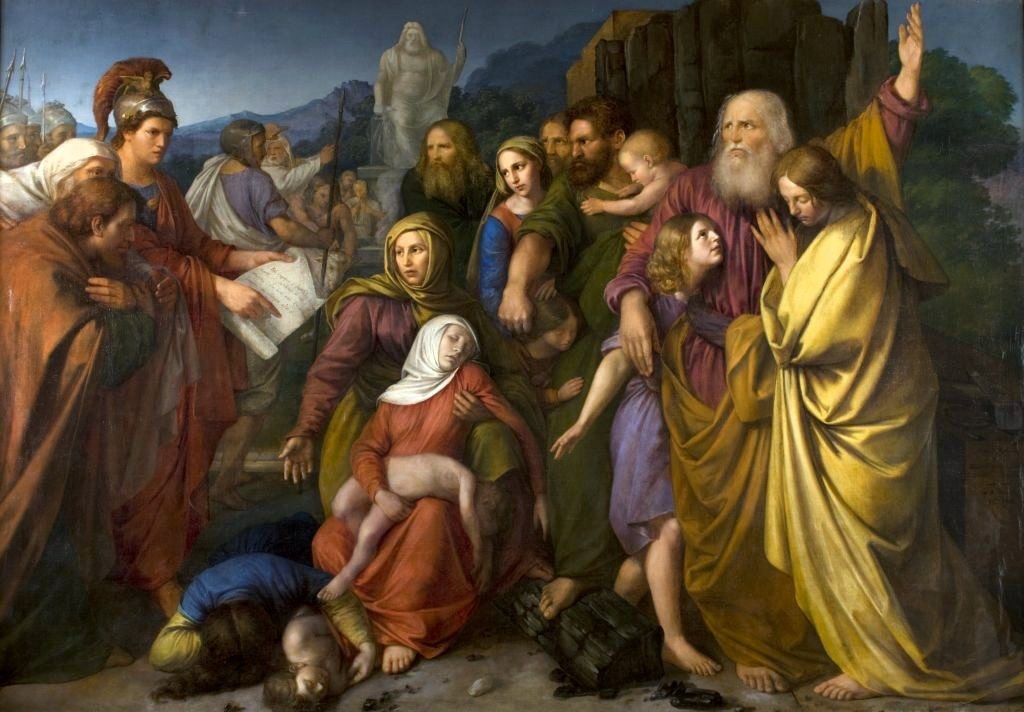 bravely endured cruel and barbarous torture: They died as faithful martyrs for not being willing to eat PORK and they had the assurance that they would be resurrected. (Read the account from 2 Maccabees below).


 Facebook
 Twitter
 GooglePlus
 RSS
 Youtube
 Newsletter
 Email Me New Posts!
