Peter’s statement “…with the Lord one day is as a thousand years, and a thousand years as one day” (2Pet 3:8) has been used to supposedly prove that time and numbers in the Bible do not have concrete value and therefore the days in Gen 1 could have lasted one thousand years or perhaps even one million. The key to understanding is the phrase “with the Lord” with which Peter describes God’s perspective to time and not man’s; he is not saying that one thousand years are equal to one day but rather in God’s economy, time is radically different and when we think that the Lord is “slack” (2Pet 3:9) we should think again. Peter wants to make clear that God’s timetable is different from ours, hence “with the Lord”.
Numbers are Literal in the Bible
Another objection made against the creation account is that numbers and days are allegorical or figurative. Signers of the Clergy Letter Project suggest the creation account is not meant to convey literal truth but simply “timeless truths.” Though there are many examples that can be brought to demonstrate that claim to be false, for brevity’ sake we will only compare the texts of Jeremiah, Daniel, and 2 Chronicles.
God told the prophet Jeremiah that the people of Judea would “serve the king of Babylon seventy years.” (Jer 25:11) Approximately seventy years later, Daniel tells us, “I, Daniel, understood by the books the number of the years specified by the word of the LORD through Jeremiah the prophet, that He would accomplish seventy years in the desolations of Jerusalem” (Daniel 9:2). Keep in mind, though the book of Daniel contains many visions, Daniel chapter 9 is him explaining an event in his life; in other words, it ought to be read as literally and historically true. In his time of prayer he interprets the prophecy of Jeremiah in unmistakable terms – he understood from the prophet Jeremiah that God would keep His people in Babylon for seventy literal years. He does not try to look for a hidden message as to what God meant by seventy years, he assumes them to be literal: exactly seventy years after the first deportation, the Jews were allowed to return to Jerusalem.
Daniel interprets and confirms that the curse given in Deuteronomy was 100% literally fulfilled through the destruction of Jerusalem. “As it is written in the Law of Moses, all this disaster has come upon us.” (Daniel 9:13) He does not seek to
Get all facts in the book.
interpret away God’s words as allegory as many do today. Daniel was much closer to and was a part of the writing of the Hebrew Scriptures – less than seventy years after Jeremiah. His own writings are also considered canonical, inspired, and authoritative. If he took such writings as literal and straightforward, how much more should we? The literal interpretation of Daniel regarding Jeremiah’s prophecy is also shared by the writer of 2 Chronicles in extremely plain language: “…to fulfill the word of the LORD by the mouth of Jeremiah … As long as she lay desolate she kept Sabbath, to fulfill seventy years…that the word of the LORD by the mouth of Jeremiah might be fulfilled…” (2Chron 36:20, 21) The author of Chronicles reiterates the period of seventy years to fulfill Jeremiah’s prophecy. There was no question in the writer’s mind that this prophecy was fulfilled completely and literally.
The final meaning refers to days of 24‑hours. The most basic way of defining a day was from evening to evening, which is indicated in the text by evening and morning. The ancient Israelites, contrary to us, started their new days at sunset. Thus, Friday night right after sunset would already be considered the Sabbath and the day would end Saturday evening at around the same time.
Another way to indicate a regular day of 24‑hours is by hayom hazeh היום הזה which is translated as “the very same day.” In Gen 7:13 we read: “On the very same day Noah…entered the ark.” Likewise, Gen 17:23 states: “So Abraham took… all who were born in his house… and circumcised the flesh of their foreskins that very same day…” In both of these passages, the word day makes reference to the same day – that is the 24-hour period they were currently in. It is clear that the word here does not refer to an indefinite period of time but rather to a 24-hour period.
Days with a Cardinal Number
When a cardinal number (one, two, three, four, etc.) appears in front of the word day, it refers only and always to one (or many) period(s) of 24 hours. There are numerous verses which elucidate this point. “But Jacob said to him… ‘And if the men should drive them hard one day, all the flock will die.’” (Gen 33:13)
What Jacob is saying to his brother Esau is that there is a limit to how far little children and cattle can go in one day. The reference is clearly to one 24-hour period of time. Numbers 11:20 clarifies the usage even more. The children of Israel complained against the LORD because they did not have meat like they had in Egypt, the very place where God rescued them from. In frustration with his stubborn children, He declares that they will have more meat than they know what to do with: “You shall eat, not one day, nor two days, nor five days, nor ten days, nor twenty days, but for a whole month, until it comes out of your nostrils and becomes loathsome to you…” (Num 11:20)
Here the meaning of day or days is clear. There would be not just one, or two, or five, or ten, or twenty days, but a whole month’s worth of meat. The meaning of the word day is augmented by the contrast with the word “month” chodesh חודשׁ, which only refers to the time of about thirty days or one cycle of the moon and never anything else.
Further proof that yom day refers to a 24-hour day when preceded by cardinal numbers is found throughout the Hebrew Scriptures. God, in explaining the judgment coming upon the world, says, “For after seven more days I will cause it to rain on the earth forty days and forty nights…” (Gen 7:4) God gave Noah another seven days – not long, indefinite periods of time, but seven 24-hour days, until the floodwaters would come. Indeed after seven literal days, the waters of the flood came: “And it came to pass after seven days that the waters of the flood were on the earth.” (Gen 7:10) Verse 11 surpasses the previous two in precision by telling us exactly when this occurred. “In the six hundredth year of Noah’s life, in the second month, the seventeenth day of the month, on that day all the fountains of the great deep were broken up…” (Gen 7:11)
This description is not just about some indefinite period of time. It was on the 17th of the second month, a very real time that the flood came. And then the record (verse 24) tells us specifically how long the waters were on the earth. “And the waters prevailed on the earth one hundred and fifty days.” One hundred and fifty days in the text is not some long, undetermined era. Some people would contend that the days of the flood are irrelevant since Noah was simply a mythical or an allegorical figure. However, if one accepts the words of Jesus and the New Testament, then one must also accept that Noah was a real person who lived through the worldwide flood. (See Mat 24:37, 38, Luke 17:26, 27, 1Pet 3:20, 2Pet 2:5, Heb 11:7) Thus, because Jesus and the disciples accepted Noah as real, we must understand the days described in Gen as being real, 24-hour days.
The list of verses in the Hebrew Scriptures is extensive which confirms that every time a number comes before day it is referring to a 24‑hour day; a few more examples clearly illustrate the principle. “Then he put three days’ journey between himself and Jacob…” (Gen 30:36). “Forty days were required for [Joseph]… and the Egyptians mourned for him seventy days” (Gen 50:3). “And seven days passed after the LORD had struck the river” (Exod 7:25). “Seven days you shall eat unleavened bread. On the first day you shall remove leaven from your houses. For whoever eats leavened bread from the first day until the seventh day, that person shall be cut off from Israel” (Exod 12:15). “Six days you shall gather it, but on the seventh day, the Sabbath, there will be none” (Exod 16:26). “Shall seven years of famine come to you in your land? Or shall you flee three months before your enemies, while they pursue you? Or shall there be three days’ plague in your land?” (2 Samuel 24:13). Although there are too many verses to list them all here, throughout the entire Hebrew Scriptures, in every case where a number precedes day, it deals with the literal usage of day rather than an indefinite period of time.
The days in Gen 1, therefore, should be understood as literal, 24-hour days due to the usage of the limitation of the evening and the morning (see also Num 28:3, 4)found throughout Genesis 1 (the fact that the sun was not created until the fourth day is irrelevant since the rotation of the earth is what constitutes a day – the light source is immaterial). Even though the evidence points to literal, 24-hour days in Genesis one, the old-earth camp is still persuaded that these days are long periods of time rather than normal (24-hour) days. They suggest that the usage of ordinal numbers (first, second, third, fourth etc.) rather than cardinals denotes different eras of time and thus the first era (day) is followed by the second era (day) etc. where each day equals an unknown but extremely long period of time in which the slow processes of evolution, with God’s help, had enough time according to Darwin’s model of slow change.
There are some fatal flaws to this theory, however, from a biblical perspective. First of all, the first day of Genesis in the Hebrew is not actually defined as the first day, but rather as day one or yom echad יום אחד. The word echad is the cardinal number one and should not be understood as first ראשׁון rishon, but as in the series one, two, three, four, etc. We have seen previously that any time day occurs with a cardinal number, it always refers to a literal, 24-hour day. So we can conclude that the first day of creation was 24 hours.
Days with Ordinal Numbers
Ordinal numbers (first, second, third, etc.) are also used in a literal sense when used with day just like cardinal numbers. Ezekiel records that on a particular (literal) day of a particular month of a particular year God again spoke to him: “Again, in the ninth year, in the tenth month, on the tenth day of the month, the word of the LORD came to me” (Ezek 24:1). Likewise, Ezra records the exact day when the temple was finished: “Now the temple was finished on the third day of the month of Adar, which was in the sixth year of the reign of King Darius” (Ezra 6:15).
We find in the book of Numbers a usage of ordinal numbers that is parallel to Gen 1. In Gen 1 we saw the chronology of creation described as oneday and then the second day, the third day etc. In Numbers 29, God lists the various sacrifices and on which day they are to be performed for the feast of Tabernacles. Notice that the days listed have the same ordinal numbers as used in Gen. “On the second day (יום השׁני yom hasheni)present twelve young bulls…On the third day (יום השׁלישׁי yom hashlishi) present…On the fourth day (יום הרביעי yom harevi’i)present… On the fifth day (יום החמישׁי yom hachamishi) present…” (Num 29:17, 20, 23, 26).
The days above were most certainly real and literal days in which specific things had to happen; they were not long drawn out periods of time. The text employs the use of ordinal numbers as does Gen 1 but here we do not conclude that those days were indefinite periods of time; they were simply days. Thus even with ordinal numbers a day is just a literal, 24-hour day.
The vocabulary and grammar of the biblical creation describe a period of seven-literal 24-hour days – unanimously affirmed by ancient Jewish and Ante-Nicene Christian commentators. Nevertheless, a God-plus-evolution myth has arisen offering an alternative interpretation of the biblical creation. The ideas range from each day being a long indefinite era of time to the Genesis account merely being a literary framework with no bearing to reality. This study seeks to prove that the seven days of creation were literal-24 days by considering: The delimiting use of a number in front of the Hebrew word “yom” (day); the literal use of numbers in the Bible, the language and the grammar of Genesis one and two, and the value of literary genre.
The importance of the literal-six day creation is underscored ironically by atheist and evolutionist R. Bozarth in the American Atheist Magazine: “The Meaning of Evolution:”
…evolution destroys utterly and finally the very reason Jesus’ earthly life was supposedly made necessary. Destroy Adam and Eve and the original sin, and in the rubble you will find the sorry remains of the Son of God. If Jesus was not the redeemer who died for our sins, and this is what evolution means, then Christianity is nothing. (R. Bozarth 1979: 30)
While the atheists are forthright in their attack on the creation, the proponents of Theistic Evolution and Progressive Creationism, who profess a belief in God as creator and evolution as his mode of creation, are forced to somehow reconcile Scripture with evolution.
The Meaning of “Day”
The keystone of whether the earth is relatively young or extremely old rests heavily on the understanding of the Hebrew word יום yom, (day). Progressive Creation theorists contend that the days in Gen 1:1-2:3 are to be understood as long, indefinite periods of time. The young earth view, however, claims that God created the heavens and the earth and all therein in six, literal 24‑hour days roughly 6000 years ago. Does day only and always refer to a period of 24‑hours or does
Get all facts in the book.
it also refer to an indefinite period of time in which millions and billions of years could have passed allowing for the Progressive Creation and theistic-evolution theories?
The word day is used in several different ways in the Bible; sometimes referring to a time in the past. Judges 18:1, for example, states “In those days…” בימים ההם bayamim hahem. This exact phrase appears 31 times in the Hebrew Scriptures. It is a very common expression and is really no different than how we in English say “back in my day” or “back in those days” referring to a period of years in our lives but stating it in days. Hence, in this context, days are understood to be referring to time in the past that probably lasted several years (there are many days in a year) though definitely not thousands or millions – something that is obvious because it talks about human history of which the Bible gives definite times.
Sometimes the biblical writers used the word day to refer to a specific time of eschatological significance such as “the day of the LORD” יום הוה yom YHWH, found 13 times in the Hebrew Scriptures (mostly in the book of Isaiah), refers to a time in the future when God will judge the world and usher in a new age. This expression seems to speak more of an event of unknown duration rather than a specific amount of time, though a period of 24 hours cannot be ruled out.
At other times, days in the plural can refer to the span of someone’s life. In Gen 5:4 we read concerning the days of Adam, “So all the days that Adam (ימי־אדם yamei-adam) lived were nine hundred and thirty years; and he died.” Here day is used in reference to Adam’s lifetime, which is described as days, but then the text very clearly goes on to clarify what is meant by days – that is the years of his life or the summation of the days of his life. This is wonderfully illustrated by the Hebrew title of the book of I and II Chronicles למלכי ישׂראל דברי הימים divre ha-yamim lemalche Israel, literally transliterated as affairs or matters of the days of the kings of Israel.
An objection raised by Progressive Creation advocate Hugh Ross states that the “day” in Gen 2:4 “refers to all six-creation days (and the creation events prior to the first creative day)… it refers to a period longer than 24 hours” (Ross 1991: 52) and therefore would support the theory that the days of the Genesis creation account long vast ages. He suggests the word for generation (toledah) underscores a long period of time. “In Gen 2:4 the plural form, generations, is used, indicating that multiple generations have passed.” (Ross 1991: 52)
Nevertheless, the Hebrew expression in the day (that the LORD God) made עשׂות ביום (b’yom asot) actually carries the force of when. The letter ב (beth) in Hebrew often designates a temporal aspect. Joüon &. Muraoka note in A Grammar of Biblical Hebrew “With the infinitive ב is used in the temporal sense”. This explains why the letter beth in בהבראם(b’hibaram) is translatedwhen they were created, a fact also supported by both the Brown Driver Briggs Lexicon, and Gesenius’ Hebrew Grammar (Kautzsch, E. and A. E., Cowley, eds 1910). B’yom is part of a three-word construct chain and it is used in relation to the infinitive asot (making) which again carries the force of when. What is important not to overlook here, however, is that when yom is used in conjunction with the preposition beth it may be understood as a less precise expression than the 24-hour day. When yom is used with a number, it always refers to a literal, 24-hour day. Furthermore, the full range of meaning of the word תולדות (toledoth), which often means generations, is in many places better translated as account or history. (See: BDB)
For those acknowledging the reality that God was the agent of creation, there are four possible answers to the question of how He did it. The first view is that God took six, literal days as understood by the plain reading of the Genesis text, which is my thesis and is demonstrated in this teaching. (See The First Six Days) The other three views consider the evolutionary model to be an established fact and therefore seek to reconcile the revelation of Scripture regarding creation with evolution. The three views are Theistic Evolution, the Gap Theory, and Progressive Creationism.
Theistic Evolution
Theistic Evolution is the most liberal of the views that ascribes to God a role in creation as being the agent that jump-started the Big Bang. According to this theory, since then He has allowed evolution to take its course thereby having very little, if any, role in His creation and dealings with man.
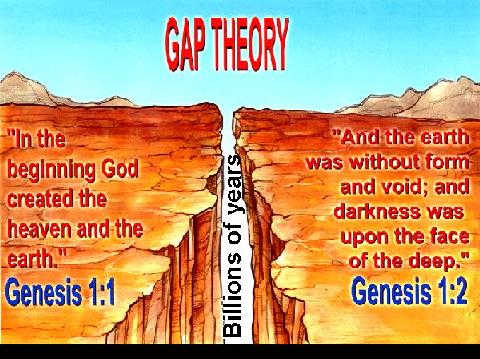
The Gap Theory
Proponents of the Gap Theory see the days of Genesis 1 as being literal days but with a time gap between Genesis 1:1 and 1:2 (some also suggest a gap between 1:2 and 1:3). The rationale for seeking a gap, nevertheless, is due to the belief that (geological) evolution is an established fact and that the Bible must be reconciled to it. Hence, a time gap is envisioned between Genesis 1:1 and 1:2 (or 1:2-1:3), which allows for the billions of years supposedly necessary for geological evolution to take place. (I deal with this question in greater depth in my DVD teaching The Angelic Domain and the Fall of Satan and in article The Angelic Domain: Created Before Genesis 1:1 or After? and in my DVD The Language of Creation)
Progressive Creationism
Progressive Creationism seeks to reconcile the belief of evolution with the Bible, not by way of a gap between verses 1:1 and 1:2, but rather by redefining six days of Genesis 1 to mean indefinite periods of time in which millions and perhaps billions of years transpired each day. They see God as being involved in the entire process of creation wherein every day, God was creating via the evolutionary process.[2] Van Bebber and Taylor point out:
According to the Progressive Creationist timeline, Adam was, in effect, created on top of a graveyard of decaying or fossilized animals. Almost anywhere he walked, the remains of millions of dead animals were somewhere below his feet — evidence of death and frequent misery on a massive scale (2006).
Thus, for the Progressive Creationist, both the Bible and the evolutionary model complement one another because the biblical creation account is better understood through the lens of evolutionary thinking. Undoubtedly, most proponents of both the Gap Theory and Progressive Creationism believe in the authority of the Bible.
How Much Time Does God Need?
Rather than ask why couldn’t God have taken billions of years to accomplish His work of creation, the better question is why didn’t God speak once and everything merely come into existence as suggested by Augustine (see chapter 7)? God, the Supreme Being by which all things exist, could have snapped His divine fingers and everything would have come into being at once. Thus, even from a literal, six-day-creation standpoint, God took His time in a big way! Why did He take so long to create everything? God purposely slowed Himself down rather than just getting it over with. The reason, found in Exodus 20:11 (and 31:12-17), is that God wanted to establish a pattern which for mankind to follow; God worked for six days and then rested and so should man.
For in six days the LORD made the heavens and the earth, the sea, and all that is in them, and rested the seventh day. Therefore the LORD blessed the Sabbath day and hallowed it. (Exod 20:11)
[2] A more predominant Progressive Creationist view is that God created the animals as we see them today (i.e. fixity of species) and they lived and died out over millions or billions of years. However, proponents of this view, such as Hugh Ross, do not believe in molecules-to-man evolution, but they do accept the evolutionary timescale for the geologic and fossil records. (Dave Wright, Answers In Genesis staff, personal communication, June 9, 2007)
The question of whether God created in literal twenty-four hours days or over eons of time has big ramifications. I appeared on Apologetics.com’s nightly show spring 2011 to defend the young earth position and the literal interpretation of the Scripture. Toward the end of the debate even our old-earth brothers conceded that looking at just the biblical evidence one has to come to a position that God created in six literal days and rested on the seventh.
The following excerpt is from the apologetics.com’s website:
The apologetics we are most familiar with is an engagement with the things that would stand against the Biblical faith, like Atheism, other religions or philosophies. But there is a sense in which apologetics is part of our sanctification and the edification of the Church, these are the “in-house” discussions. Matters within the family of faith that we hope to iron out between us. Some of these in-house kinds of discussions include Calvinism or Arminianism, Eschatology, Presuppositional or Evidential apologetic approaches, Baptism of Children, Wine or Grape Juice…
Of these, none requires as much care as the question of origins. Partly because it affects other doctrines and partly because it affects some of our interactions with the world.
Young Earth and Old Earth creationists share a single minded dedication to the truth of the Bible, and a deep desire to understand God’s revelation about where everything comes from. Staff apologists, Lindsay Brooks and Sam Welbaum are accompanied by Elder Seth Stark of Communion Presbyterian Church of Irvine and by Author of “The First Six Days” Douglas Hamp to try to come to terms with what the Bible teaches on origins. Is the world 6-10 thousand years old, or much older?
 used to supposedly prove that time and numbers in the Bible do not have concrete value and therefore the days in Gen 1 could have lasted one thousand years or perhaps even one million. The key to understanding is the phrase “with the Lord” with which Peter describes God’s perspective to time and not man’s; he is not saying that one thousand years are equal to one day but rather in God’s economy, time is radically different and when we think that the Lord is “slack” (2Pet 3:9) we should think again. Peter wants to make clear that God’s timetable is different from ours, hence “with the Lord”.


 around the same time.
 offering an alternative interpretation of the biblical creation. The ideas range from each day being a long indefinite era of time to the Genesis account merely being a literary framework with no bearing to reality. This study seeks to prove that the seven days of creation were literal-24 days by considering: The delimiting use of a number in front of the Hebrew word “yom” (day); the literal use of numbers in the Bible, the language and the grammar of Genesis one and two, and the value of literary genre.
 Bang. According to this theory, since then He has allowed evolution to take its course thereby having very little, if any, role in His creation and dealings with man.


 Facebook
 Twitter
 GooglePlus
 RSS
 Youtube
 Newsletter
 Email Me New Posts!
